Recent Blog
Recent Blog

10 November 2017

Injecting innovation into the heart of Australian healthcare

Author :
Following the approval of Australia’s National Digital Health Strategy spanning 2018-2022, the healthcare sector now has a mandate for movement to digital platforms.

Hospitals around Australia are launching a number of innovative initiatives in line with the agenda which strives to “put the consumer at the centre of their health care and provides choice, control and transparency” according to health ministers.

Here are some of the most exciting projects of the year:
  •          St Vincent’s Melbourne trial of automation in microbiology lab
St Vincent’s Hospital is the first pathology lab in the world to trial new technology to automate the analysis of microbiology lab samples. The machine will improve the efficiency of microbiology labs and enable the faster diagnosis and reporting infectious diseases.
  •          Metro North Hospital and Health Service move to cloud platforms
Queensland’s largest public hospital and health service will migrate to the Nutanix Enterprise Cloud Platform with the goal of improving patient care and the flexibility of delivering clinical information systems. According to Nutanix, “the platform is supporting around four times its previous workload and with additional capacity to spare.”
  •         The country’s most advanced digital hospital opens its doors
The $2.3 billion Royal Adelaide Hospital opened its doors in September boasting an array of digital equipment one would expect to see in the hospital of the future. Electronic tags keep track of equipment and patients, wireless patient nurse call system, electronic bedside devices, distributed medical imaging and self-service electronic kiosks is just some of the tech on hand, according to CIO.com.au.
  •          Artificial Intelligence which alerts citizens at risk
Clinicians and IT experts in South Australia have begun development of cloud-based AI which analyses health data and intervenes when it finds anything of concern. Country Health SA’s Integrated Cardiovascular Clinical Network is leading development of the platform which collates clinical data and conducts automatic health assessments.
  •          Lithgow hospital rolls out new x-ray technology
In an Australian first, the new x-ray technology will generate clearer images more quickly. Worth $700,000, the new machine exposes patients to drastically reduced levels of radiation and the images are often ready before the patient has even left the x-ray room.

Written by: Claire Dowler

Claire Dowler is a Senior Conference Producer with Akolade. She recently graduated with a double degree: a Bachelor of Journalism and a Bachelor of Media and Communications Studies majoring in International Communication. Claire minored in sarcasm and puns.

A ballroom-dancer who collects salt and pepper shakers and volunteers for animal rescue, you might say Claire has eclectic interests.


03 November 2017

Putting the brakes on crowd attacks

Author :
Terrorists are looking to cause the maximum amount of harm and disruption in order to attract mass media attention. Protecting people in crowded places requires attention to the vehicle management, urban design and architectural features of a space.  This means targeting high-profile locations such as landmarks in major city centres, sports events and stadiums or indeed public spaces that attract a high footfall.

While there is no specific intelligence to suggest a terror threat is imminent, the global reality means local police has to put safeguards in place where large crowds are expected to gather. As terrorist tactics evolve and shift, countermeasures also need to adapt to create resilience to different threats. One of the main considerations of counter-terrorism design is preventing unauthorised vehicles from getting too close to, or entering a site or building, and making sure that the integrity of stand-off distances can be maintained.

The Australian Government launched the Australia’s Strategy for Protecting Crowded Places from Terrorism and has been developed in close partnership with the states and territories, local government, police and the private sector. The Strategy involves four core elements which provide a structure for building a consistent national approach to protecting crowded places that can be applied flexibly throughout Australia. These core elements are building stronger partnerships, enabling better information sharing, implementing effective protective security and increasing resilience.

Protecting crowded places from terrorism is not just a job for governments, it is a responsibility shared by the private sector and the community. The plan, called Australia's Strategy For Protecting Crowded  Places From Terrorism, was given to Australian businesses and councils, and outlines ways to prevent vehicle attacks similar to those seen in Barcelona, Nice, and London.

The success of this Strategy rests on sustainable and strong partnerships across Australia between all governments and owners and operators of crowded places, including businesses and local governments.

Prime Minister Turnbull stated: “What we've done with this crowded places strategy is we have set out a series of tools by which owners and operators of venues... are able to assess the vulnerability of their site, see how they can make it safer and know where to seek advice from police. We are relentlessly, tirelessly, working to keep Australians safe.”

The strategy is another impost on a very busy Australian intelligence and policing enterprise that is still absorbing the government’s significant redesign of its member agencies through the soon to be ministry of home affairs and the office of national intelligence. Yet the strategy has many merits that require further careful consideration and development.

Akolade's 2nd annual Public Venue Security and Safety Summit will bring together leading security professionals to explore the implementation of effective and practical strategies to ensure operational continuity of public venues, events and facilities.

Written by: Nicolas Verbeeck


Nicolas was born in Belgium and became an expert in consuming excellent beers, chocolate and waffles. During the winter period you can find him on a hockey pitch and in summer he loves to go for a swim or a surf. In 2013 Nicolas was wondering what the beers, chocolate and waffles would taste like in Australia and never came back. One reason… the weather. Nicolas obtained a masters in International Politics and tries to use this background to produce excellent conferences at Akolade.


Leaders gather to improve academic outcomes for Indigenous students - National Indigenous Education Forum 2017

Author :
People from across Australia’s schools, Indigenous communities and government bodies gathered for the National Indigenous Education Forum on the 18th-20th of October.

During the three days, over 30 community leaders shared their stories and case studies on how to improve academic outcomes for Aboriginal and Torres Strait Islander students.

The Hon. Eva Lawler, Minister for Education in the NT opened day one of the conference with an overview of the NT government’s initiatives to support and improve the education sector in the NT. Delegates also heard Clément Chartier from Métis National Council in Canada share his story on his peoples’ battle in gaining recognition from the government.

Other presenters on day one also shared their stories on how to engage with communities, elders and families to see improved outcomes for students and emphasised the importance of ensuring the community is part of the decision making and is the driving force behind the education in the area.

Day two was opened by Selena Ubio, Member for Arnhem in the NT and Assistant Minister for Remote Education and Families as First teachers. Her energy and passion was infectious and gave attendees a great insight into what it’s like teaching in remote areas.

Another highly appreciated speaker on day two was Noel Pearson, founder of Cape York Partnership, who advocated for the importance of Indigenous independence and the need for Indigenous public schools.  Grant Congdon, Principal of the Horowhenua College in New Zealand, shared his story on how they’ve managed to see their Maori students excelling academically.

Other presenters shared case studies on how to increase Aboriginal and Torres Strait Islander leadership, build cross-sector partnerships and support students during transitions into further education, employment and adulthood.

The forum enabled participants to network and share stories with others from the education sector and provided an empowering environment with new energy to keep up the work to improve educational outcomes for Aboriginal and Torres Strait Islander students.

Written by : Mimmie Wilhelmson


Mimmie grew up in Sweden and first came to Australia as a backpacker after high school. After travelling around the country for two years she returned to Europe and pursued a Bachelor’s degree in Journalism in London. But the longing for Australia and the sun became too strong. After having worked for some time in the media industry, Mimmie decided to make a change and swap the news for conferences. She now gets to do what she loves the most, meeting new people and keep learning about cultures and issues while producing conferences on current topics.


27 October 2017

Social media teams in government embracing shift to video

Author :
You sit up quickly when Facebook tells you Australians spend on average just 1.4 seconds looking at a post on a mobile phone. How do you get a message across in such a short time?
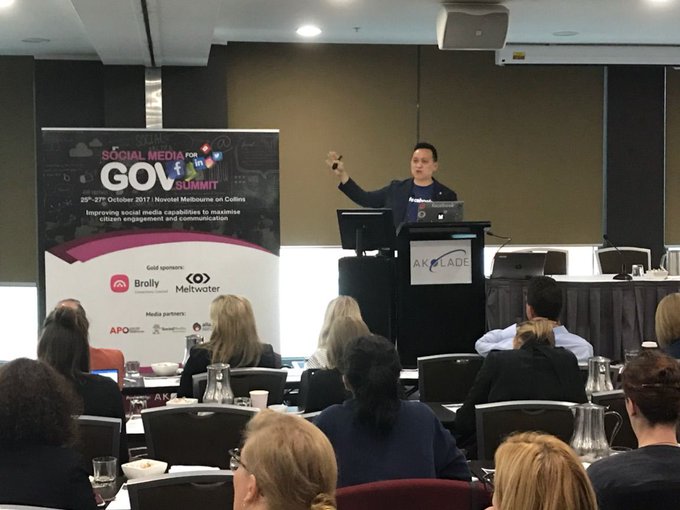
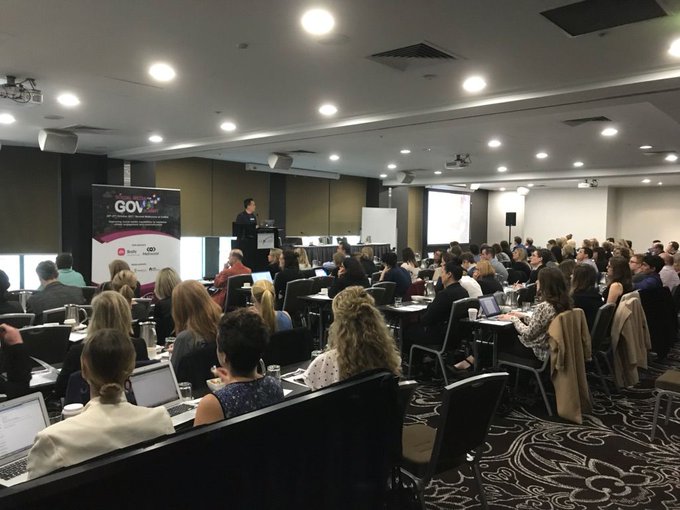
It was just one of the many challenges and insights at this 9th Social Media in government conference by Akolade Australia in Melbourne.
How to harness social media video and put communities at the centre of policy remain top priorities for communications in the public sector.

Key takeaways from the experts

Having Facebook and Instagram in the room was clearly a draw-card. You don’t often get updates from the social media giant about Australian numbers, but Facebook’s APAC Government and Policy lead Roy Tan was there to deliver them:
  • 12 Million Australians are checking Facebook every day.
  • More than 90 percent of those check on Mobile
  • They spend about 1 hour and 40 minutes a day on Facebook and check the platform about 14 times a day.


View image on TwitterView image on Twitter

It's a full house today @ . Pleased to have Roy from  introducing  ,  & how to's on reach for gov
The advice from Facebook for government was clear: be authentic and use lots of video to do it. This, not surprisingly, is a challenge for many agencies. Video is expensive and requires technical skill. Many of the attendees talked about a shift to inhouse video production and low-cost video production as a way to get value for money.

Decentralise and federalise

A recurring theme from speakers such as Mark Bayly from Victoria Police and Susan Manniche from the Bureau of Meteorology was the need to decentralise and trust content creators across an agency. For example, the Bureau’s social media team has several hundred people (meteorologists or comms) trained and authorised to Tweet.
How to leverage content across a government agency was also the message in my own presentation.  I appealed for agencies to have a policy and governance framework that frees up content creators or channel owners. Let communication teams know what they can and can’t do on a platform such as Facebook on behalf of the agency. Clear boundaries means better response times for customers.

What happens next?


Despite a decade of rapid growth in digital engagement, many government agencies are still grappling with the basics. This is a reflection of low risk appetite, and ultimately a desire to get the strategy right and ensure value for money. Another commonality was evident from questions from the conference floor time and time again: social media is worth the learning curve because social media can put the customer front and centre of communications.

Guest blog written by:
John Kerrison


John Kerrison was a broadcast journalist for 11 years who worked in Sydney, Adelaide and Canberra. He hosted Technology Behind Business for Sky News. He has a Masters in Organisational Communication from Charles Sturt University with a focus on new media and crisis communication. He currently works for the NSW Government in a strategic role, advising on social and digital media.

25 October 2017

5 predications about the future of retail stores

Author :
“By 2022, brick and mortar retail spaces will be little more than showrooms” Eddie Machaalani & Mitchell Harper, Co- CEOs of Bogcommerce.

In an era of unprecedented ecommerce disruption, the burning question facing all bricks and mortar retailers is what does the future hold for stores?

As a small child I can remember holding my mother’s hand tightly as we walked through crowded department stores, afraid to let go for fear of being lost in amongst the masses of insatiable shoppers.

 Fast forward a few decades and the differences are stark. I recently took my little girl to a household name department store. There was some traffic on the ground level but as we explored the upper levels, a common feature emerged; silence. The top floor appeared completely empty, my daughter marvelled at her new found playground, playing hide and seek in and around the clothes racks.

It is no secret that the technology era has dramatically influenced consumer shopping behaviour. Whilst online shopping statistics rising, what we do know is there is something about the in store shopping experience that still appeals to us.

With the traditional notion of a store quickly becoming extinct, what does all this mean for the future of stores? 

1. Online shopping won’t replace bricks and mortar 
I think bricks and mortar is an amazing opportunity to use our stores and our store staff as a vehicle to truly engage with the community in a way no other retailers are doing” Jim Brett, president, West Elm
What we know is that whilst we like convenience and speed we also like the ‘experience’ of shopping. Furthermore, there are particular products that retailers struggle to maintain online sales for. If we know physical stores will exist in the future, the question is in what form? Predications suggest that the stores of the future may be points of purchase but not in the traditional sense, perhaps they will be more like experience hubs for customers to feel, touch and compare items that they then order for home delivery.

2. Stores will become more responsive like platforms
Like smart phones, stores are heading towards a more responsive, agile fulfilment model fuelled by the latest data analytics technologies. ZARA, for example, has such a responsive supply chain model in place that they only stock the exact number and type of apparel in each specific line that they will sell based on the strength and accuracy of their demand planning and forecasting. This enables them to ensure their physical store space is optimised at all times. 

3. Retailers must optimise selling space 
Following on for the ZARA example, JB HI – FI have developed clever strategies to ensure that their stock is selected in accordance with what their customers want to ‘experience’. That is in contrast to the more transactional items that their customers are happy to buy online. This is an excellent way to make selling space count! 

4. Retailers will diversify last-mile fulfilment options
With Ecommerce changes impacting how retailers and 3Pls do business, last mile fulfilment models are being upended.  Trends like crowdsourcing apps and same-day, more convenient delivery are driving exciting innovations in last mile fulfilment that will continue to emerge in the coming years. Via crowdsourcing, UberRUSH for parcels, Postmates, Deliv and Amazon Flex all currently offer spot-market deliveries.
Meanwhile, with drones offering a means of providing ‘next level’ delivery convenience, early adopter Amazon is calling drone delivery the future of last mile fulfilment and others are quickly jumping on board. In 2016, Dominos pizza delivered a pizza via drone (partner Flirtey), to a customer's door in Auckland. 

5. Stores will become much more experiential—or cease to exist!
It seems that in order to survive the new on demand economy, retailers must compete on experience. Apple is an excellent example of a retailer that providers their customer base with exceptional in store experience. With staff always at hand, customers can try products, ask questions and learn about new functions. In addition, Nordstrom’s new ‘Reserve & Try in Store’ feature enables customers to choose items online and try them on in person in store. Both these examples show ways in which retailers are offering valuable instore experience to drive traffic to their shop fronts.  


With ecommerce transforming the retail landscape, disruption is ever present. And with any big change, there comes opportunity and challenge. One thing is for certain the stores we see and experience today will look vastly different in the next 10 years. The retailers that will thrive in this new environment will be adaptable, innovative and above all responsive. It’s an exciting time for those who are ready, willing and able to jump on board and embrace the new world. The question is, are you?  

Research sources include:


Written By: Luana Clarke

From a young age Luana wanted to become a teacher. She would line up her teddies in a row and teach them for hours on end. However, she eventually grew tired of their nonchalance and has ended up leading a team of producers instead- which she finds far more fulfilling and stimulating!

Luana comes from an experienced production and management background. She has produced and topic generated events across Asia and Australia.

Luana enjoys learning about emerging trends and drivers for change and loves the notion of the 'butterfly effect'- that change can start small but grow immeasurably through a ripple effect.

24 October 2017

Risk mitigation in an era of digital – can workforces keep pace?

Author :
The rise of ‘digital risk’ in the corporate environment means facing a whole new dimension of threat.

Cyber attacks are becoming increasingly sophisticated, widespread and complex in today’s digital landscape. We might be reasonably good at managing predictable, lower-level risks, but organisations often have a false sense of security about their ability to anticipate and deal with more hazardous fraud threats that evolve rapidly in a digitally-connected world - recent reports actually indicate that fraud risk has been identified as the most expensive crime category in Australia.

A digitized risk function provides better monitoring and control as well as more effective regulatory compliance… but this starts with people. To keep pace in the evolving digital economy, it’s fundamental for workforces to be upskilled and get proactive about tackling new and emerging threats. Organisations need to be driven by digital growth and adaptable to change.

Ultimately, the integration of digital risk-specific goals into organisational processes, data and behaviours can not only significantly reduce losses and fines in core risk areas, but also improve organisational efficiency and create widespread value.

Companies need to face up to digital disruption and embrace new technologies to stay resilient. But what’s the best practice for digitizing operational practice and aligning with corporate strategy?

Join us at the Australian Cyber, Fraud and Risk Summit 2018. This event is uniquely focussed on exploring all the critical topics within the domain of cyber crime, risk, fraud and corruption – a discussion not to be missed!

Written by: Beth Hampton

Beth came to Australia in late 2016. Having spent some time travelling through Southeast Asia and briefly living in Singapore – she was ready to embrace the lifestyle of a working Sydneysider!Beth grew up in London, and completed her degree in Psychology at the University of York. She always dreamed of landing a job in the police, but figured it was worth swapping the handcuffs and late shifts for an exciting new city and a job full of fun and opportunity in a fantastic company like Akolade!
Beth loves cooking, playing the piano, terrible British soap operas, an ice-cold G&T and exploring new places.

20 October 2017

What does it take to be an ideal EA?

Author :

Behind every great executive is an even greater executive or personal assistant. But what qualities make the difference between a good and a great EA?

1. Master of the calendar

At all levels of government, executives live and die by the calendar. Between meetings, appointments, conferences, calls and presentations, the EA is like the air traffic controller of your life which keeps them from colliding.

2. Priorities, priorities

To be a master of the calendar the EA must often have the ability to prioritise as conflicting appointments arise. Thinking strategically and bringing only important items to their attention can be a desirable characteristic of an EA as you can use your discretion to deal with the more trivial items on the agenda appropriately.

3. They know what matters

Doing well as an executive only means so much if you don’t have time to spend with family and friends- not to mention getting your R&R. Balance is key and your executive assistant will help you achieve it.

4. There’s no ‘I’ in team

An executive and their EA is a partnership and establishing a working relationship based on trust and respect is crucial both to workplace wellbeing but also developing a dynamic skill-set for progressing in your own career. They should collaborate with their executives and work towards mutual goals.

5. They look after themselves too

A truly successful EA takes care of themselves as well as their executive. You can’t perform at your best if you aren’t energised and focused. A great EA has the ability to separate work from their home life which often means turning off emails- or at least dedicating a window of time to handle anything urgent and marking the rest for the following day.

Written by: Claire Dowler

Claire Dowler is a Senior Conference Producer with Akolade. She recently graduated with a double degree: a Bachelor of Journalism and a Bachelor of Media and Communications Studies majoring in International Communication. Claire minored in sarcasm and puns.

A ballroom-dancer who collects salt and pepper shakers and volunteers for animal rescue, you might say Claire has eclectic interests.